


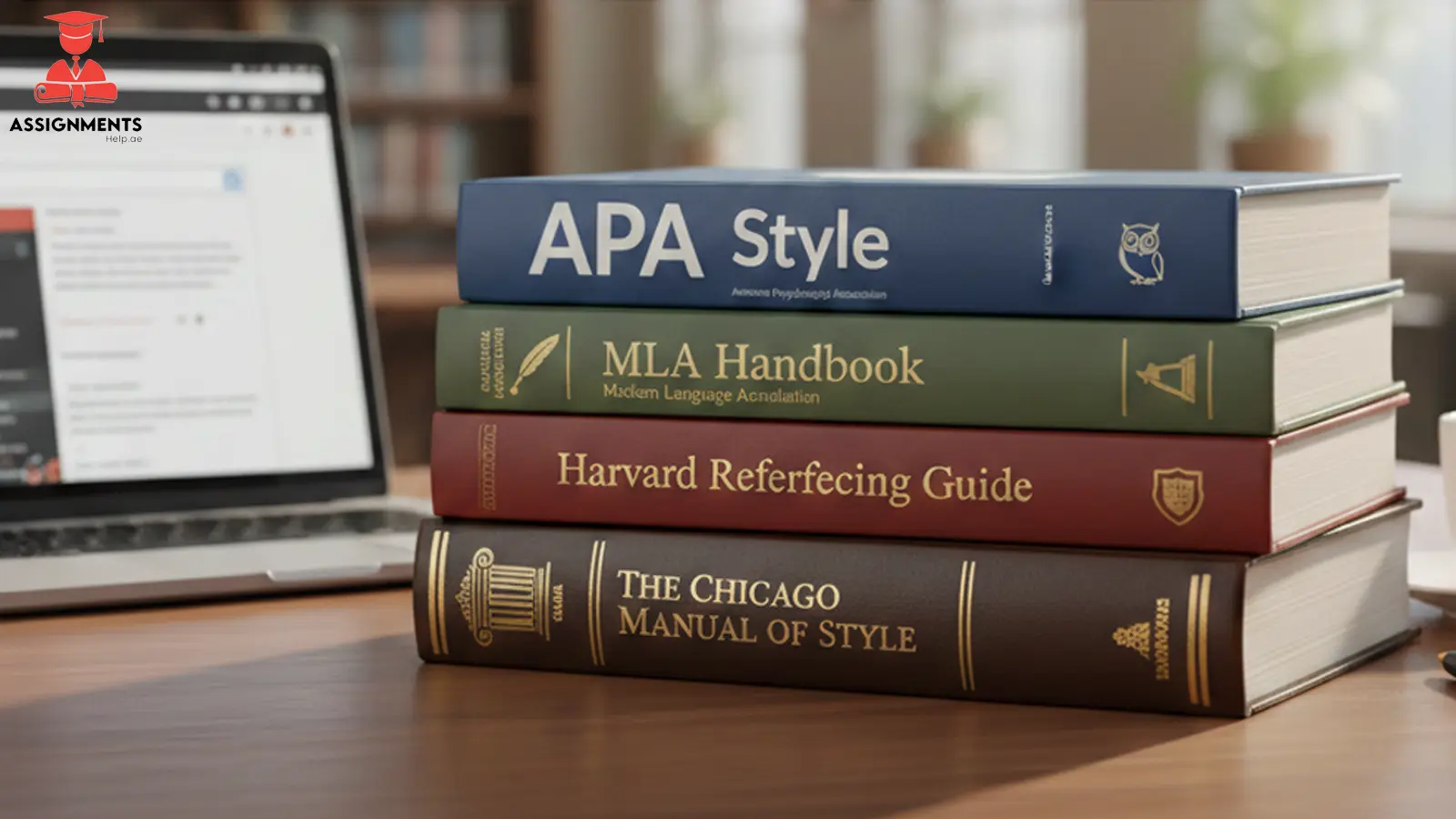
Every year, queries on citation styles climb at campuses nationwide. Though thoughts flow easily, lining up references trips up plenty of learners.
What does academic referencing really mean?
Giving proper nods to sources keeps track of where facts land in your work. From books to websites, every borrowed thought gets a mention so truth stays clear. Names behind studies, quotes, or data stay visible through small paper trails. This approach strengthens credibility and supports clear academic communication.
Not every citation method gets equal attention—four stand out through common use despite plenty of existing. Institutions and learning platforms such as ALEF Education emphasize the importance of using correct referencing styles to maintain academic integrity and improve learning outcomes.
• APA
• MLA
• Harvard
• Chicago
One follows specific patterns when citing inside the text or listing sources at the end. This walkthrough breaks down every system plainly, using real-life samples ready for your work.
What Is Referencing & Why It Matters
Definition of Referencing
Referencing has three main parts. These parts work together and each one has a clear job.
- Citation: A short note inside your writing that shows where the information came from. Proper citation is essential in academic writing because it helps readers trace ideas back to their original sources.
- Reference list: A list at the end of your work that shows full details of every source you used. It comes after everything else you wrote.
- Bibliography: A bibliography is a list of all the sources you looked at, even if you did not use them in your writing. Some styles use the word “bibliography” instead of “reference list.”
You must cite when you:
- Use a sentence copied exactly from a source
- Paraphrase someone else’s idea (write it in your own words)
- Use facts, numbers, or research results
- Use charts, pictures, or tables
- Talk about ideas or arguments created by someone else
If the idea is not your own, it probably needs a source.
Why Students Must Use Referencing
One way to stay out of trouble is to keep your work original. Schools now use special software that can quickly find copied work. In recent years, more students have been caught for copying. Even a small mistake, even if you did not mean it, can cause problems.
Referencing also makes your work stronger. When you show that experts agree with your ideas, your writing feels more real and trustworthy. This is especially important in essay writing, where supported arguments and evidence-based discussion directly affect grades.
Following the rules is important when you hand in your work. Some schools require a certain style. If you do not follow the correct format, you may lose marks.
Types of Sources That Require Referencing
You must reference:
- Books
- Journal articles
- Websites
- Interviews
- Government reports
- Charts and images
- Conference papers
In simple words, if the information did not come from your own, you should give credit.
APA Referencing Style (7th Edition)
What Is APA Style and When Is It Used
APA stands for the American Psychological Association. This style is often used in subjects like psychology, education, nursing and business. These subjects study people and human behavior.
APA uses an author–date system.
In Text Citation Rules (APA)
Basic format:
- Paraphrasing: (Author, Year)
- Direct quote: (Author, Year, p. X)
Examples:
Single author (paraphrase):
(Smith, 2022)
Two authors:
(Smith & Jones, 2021)
Three or more authors:
(Smith et al., 2020)
Direct quote example:
“Clear academic writing is very important for students” (Brown, 2019, p. 45).
Remember:
- Add page numbers only when you copy the exact words (direct quote). Do not add page numbers when you are paraphrasing.
Reference List Formatting (APA)
References
The reference list comes at the end of your paper. Sources are listed in alphabetical order (A to Z)
Book example:
Smith, J. (2022). The silent forest. Oxford University Press.
Explanation:
- Use only the author’s initials (not full first name).
- Put the year in brackets.
- Italicize the book title.
- Do not include the location of the publisher.
Journal Article With DOI
Brown, T. (2021). Student motivation in higher education. Journal of Academic Studies, 15(2), 34–48.
https://doi.org/10.1234/jas.2021.5678
If a DOI (Digital Object Identifier) is available, always use it.
A DOI is better than a website link because it does not usually change.
If there is no DOI, you can use a website link but only if the article is online. Some links stop working, so only include it when needed.
Webpage example:
University of Manchester. (2023). Academic writing guide. https://www.manchester.ac.uk/writing-guide
APA Common Mistakes
- Writing “and” instead of using & inside brackets (should be: Smith & Jones, 2021)
- Forgetting to italicize book or journal titles
- Forgetting page numbers when using direct quotes
- Using wrong capital letters in titles
- Listing references in random order instead of alphabetical order
MLA Referencing Style (9th Edition)
What Is MLA & Where It’s Used
MLA (Modern Language Association) guides many in school writing. Humanities subjects often follow its rules - English literature, Art history and cultural studies.
MLA uses author–page format.
In-Text Citation Rules (MLA)
Basic format:
(Author Page)
Example:
(Smith 45)
Notice there is no comma and no year.
If the author is mentioned in your sentence:
Smith argues that academic skills are essential (45).
Works Cited Page Format (MLA)
Works Cited
Entries are in alphabetical order.
Book example:
John Smith wrote a book called Understanding Research Methods. Published by Oxford University Press. Came out in 2022.
Explanation:
Full first name
Last on the list is the year
Commas separate parts
Journal article example:
Brown, Thomas. “Student Motivation in Higher Education.” Journal of Academic Studies, vol. 15, no. 2, 2021, pp. 34-48.
Website example:
Manchester University. “Guide to Academic Writing.” 2023, available at manchester.ac.uk/writing-guide.
MLA Common Mistakes
- Adding the year in in-text citations
- Using wrong punctuation
- Forgetting italics
- Last thing - skip the page numbers when listing journal articles
Harvard Referencing Style
Harvard Referencing Explained Simply
Across the UAE, many universities pick Harvard for citing sources in different subjects. Like APA, it uses the writer and year instead of numbers. However, formatting details differ slightly.
In-Text Citations (Harvard)
Basic format:
(Author Year)
Example:
(Smith 2022)
For direct quotes:
(Smith 2022, p. 45)
Multiple sources in one sentence:
(Smith 2022; Brown 2021)
Reference List Format Harvard
Title: Reference List
Alphabetical order.
Book example:
Smith, J 2022, Understanding research methods, Oxford University Press, Oxford.
Journal Article Example With DOI:
Brown, T 2021, ‘Student motivation in higher education’, Journal of Academic Studies, vol. 15, no. 2, pp. 34–48, doi:10.1234/jas.2021.5678.
If there is no DOI, add a website link instead, include it when your school asks for it.
Harvard Common Mistakes
- Mixing up APA punctuation
- Missing commas
- Wrong use of italics
- Not checking your school’s specific Harvard style version
Chicago Referencing Style (Notes and Bibliography)
When to Use Chicago Style
Chicago style is common in history, fine arts and publishing. It has two systems:
- Notes and Bibliography
- Author–Date
Most humanities courses use Notes and Bibliography.
Chicago In-Text Notes
Instead of brackets, Chicago uses footnotes.
Example in text:
Academic integrity is essential.^1
Footnote at bottom of page:
- John Smith, Understanding Research Methods (Oxford: Oxford University Press, 2022), 45.
Bibliography Format (Chicago)
Title: Bibliography
Book example:
Smith, John. Understanding Research Methods. Oxford: Oxford University Press, 2022.
Notice that formatting differs from the footnote version.
Chicago Common Mistakes
- Confusing footnote and bibliography formats
- Incorrect punctuation
- Missing page numbers in footnotes
- Not shortening repeated citations properly
Side-by-Side Comparison
| Style | In-Text Format | Reference List Title | Common Fields | Best For |
|---|---|---|---|---|
| APA | (Author, Year) | References | DOI, Year | Social Sciences |
| MLA | (Author Page) | Works Cited | Page numbers | Humanities |
| Harvard | (Author Year) | Reference List | Year, URL | Multi-discipline |
| Chicago | Footnotes | Bibliography | Full publication | History, Arts |
This table can help you quickly identify key differences before you start formatting.
Tools and Resources to Automate Referencing
Referencing tools can save time and reduce stress. Research shows citation tools increase accuracy and save 40% of time students spend on referencing.
Popular tools include:
- Zotero
- Mendeley
- Citation Machine
- Better Cite
Choose a tool that integrates with Word or Google Docs. Always double-check generated references. Tools are helpful, but they are not perfect.
Common Referencing Mistakes and How to Fix Them
Missing Author or Date
If no author is available, use the organisation name. If no date exists, use “n.d.” in APA or check your style guide.
Improper Capitalisation and Italics
Check whether the style uses sentence case or title case. Italicise book and journal titles correctly.
Incorrect URL or DOI Formatting
Use a DOI whenever available. It is more reliable than a URL. Avoid long tracking links.
Not Updating Style Editions
Always check if your university requires the latest edition, such as APA 7th or MLA 9th.
Create a simple checklist for yourself before submission.
Checklist Before Submission
- Have you cited every source used?
- Do in-text citations match your reference list?
- Is everything in alphabetical order?
- Are italics and punctuation correct?
- Have you followed your tutor’s guidelines exactly?
Spending 10 minutes reviewing this can protect your marks.
Conclusion
Referencing is very important because it helps you avoid plagiarism, strengthens your ideas, and shows that you take your academic work seriously. Most teachers consider correct citation essential for maintaining academic integrity. Different subjects follow different referencing styles—APA is common in social sciences, MLA is widely used in humanities, many universities in the UAE prefer Harvard, and Chicago is popular in history and the arts. It is important to stay consistent with one style throughout your work, as understanding the pattern makes referencing much easier. Regular practice improves accuracy, and while citation tools can be helpful, they should always be double-checked for errors. Above all, follow your tutor’s instructions, as their guidelines take priority over general rules. Although referencing may seem difficult at first, with time and careful effort, it becomes manageable and can significantly improve your confidence and grades.