


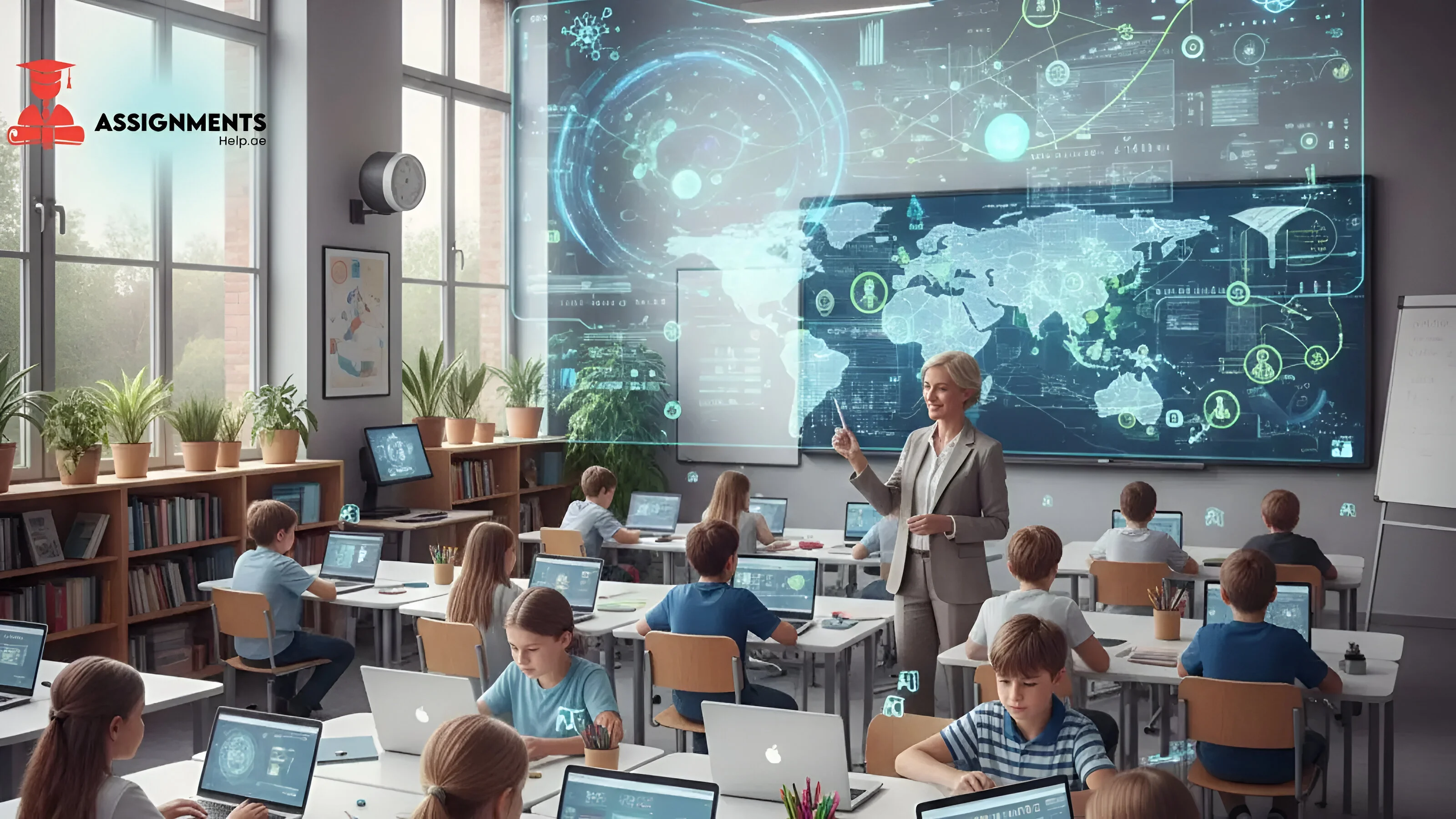
Education is evolving faster than ever before. The shift from blackboards to smartboards was huge, but what is happening now is even bigger. We have stepped into a learning era where AI in Education is no longer only a concept discussed in tech seminars. It is real, present in classrooms, digital learning platforms, and even everyday study routines. Artificial intelligence has become a powerful tool for students and teachers, supporting efficiency, reducing workload, and helping personalize learning for every individual.
Children today learn through digital content, online quizzes, interactive 3D simulations and AI-based study apps. Teachers get support in grading, managing attendance, preparing lesson plans and identifying weak areas in a class. Parents get performance reports and learning analytics in seconds. In simple words, artificial intelligence in education is reshaping how learning works.
What is AI in Education Exactly?
AI in Education refers to the use of artificial intelligence systems (machine learning, automation, natural language processing, chatbots, recommendation systems) to assist academic learning. It means software that adapts to student performance, apps that solve doubts instantly, tools that help with assignments, and systems that make teaching easier for educators.
Whenever a platform automatically generates quizzes, checks plagiarism, gives instant feedback or guides a student according to their level, AI is working behind it.
Why AI Matters in Modern Learning?
One classroom cannot cater to 30 different minds equally. Every child learns differently. A traditional system struggles to identify individual learning gaps, but AI bridges that gap by studying student behavior and progress patterns.
There are several reasons why AI adoption in education is increasing globally.
Reasons AI is becoming important in education:
- It creates personalized learning environments.
- It minimizes teacher workload.
- It makes education accessible to remote or differently-abled learners.
- It improves assessment accuracy.
- It enhances engagement using interactive digital tools.
Today, many schools and colleges are actively adopting AI-supported systems to improve educational outcomes.
AI in Schools – Real Examples of Transformation
Practical implementation of AI in Schools has already begun. Digital attendance systems, AI tutors that answer questions instantly, virtual classrooms for remote students, automated homework evaluation and smart monitoring tools are becoming common.
Real examples happening inside schools:
- AI tutor/chatbot software helping students solve questions after school hours.
- Plagiarism checking systems ensure originality in assignments.
- Learning apps adjust difficulty based on student performance.
- Speech-to-text and text-to-speech for special needs students.
- Gamified learning systems that turn lessons into interactive challenges.
Classrooms are not limited to books anymore. A student stuck on a math problem doesn’t need to wait till next class. AI-based assistance can help instantly. This makes learning continuously active.
Advantages of AI in Education (Deep Understanding)
The benefits of artificial intelligence in education are massive. They touch each side of the ecosystem – students, teachers, institutions and even parents.
1. Personalized Learning for Every Student
AI studies how a student learns. If someone is fast, content becomes advanced. If someone struggles, lessons simplify. This reduces pressure and ensures that no student is left behind. A teacher alone cannot personalize learning for each child individually, but AI can do it in seconds.
2. Instant Feedback and Smart Assessment
Students usually wait days or weeks for feedback. AI tools like automated exam checking and real-time scoring reduce this time. They also point out mistakes clearly, helping students improve faster. In Emsat Practice, AI-generated feedback helps students prepare, analyze weak areas and measure improvement.
3. Support for Teachers Instead of Replacement
AI does not replace teachers. It supports them. Work like grading papers, checking plagiarism, creating quizzes and managing data becomes easier. Teachers save time and focus more on creativity, student development, emotional support and class interaction.
4. Education Becomes More Accessible
AI assists students with disabilities using voice commands, screen readers, real-time language translation and visual learning tools. A visually impaired student can learn through audio. A hearing-impaired student can learn through live subtitle generation. Education becomes inclusive.
5. More Student Engagement and Interest
Interactive content motivates students more than plain text. VR experiences, simulations, educational games and storytelling-based apps increase curiosity. When learning becomes enjoyable, better grades follow automatically.
6. Smarter Academic Decisions
AI analyzes attendance, behavior, strengths and weaknesses. Teachers and parents receive proper reports, which help in planning support strategies. Instead of guessing why a student is weak in a subject, AI shows real analytical reasons.
How AI Helps Students in Assignments & Writing Tasks?
Students use AI tools for research, structure building, grammar improvement and content clarity. During university assignment preparation or essay writing, AI acts like a digital helper – guiding, suggesting and correcting.
It can generate topic outlines, summarize long content, find data resources, check grammar and even guide referencing formats. But responsibility matters. AI should assist understanding, not promote copy-paste learning. Real learning happens when AI is used to understand concepts – not just complete tasks faster.
Students using AI effectively:
- Use AI for brainstorming ideas.
- Improve grammar and writing flow.
- Summarize or expand content logically.
- Practice quizzes through AI-based modules.
Balance is the key.
Challenges of AI Integration in Education
Every technology has limitations and risks. Understanding them is necessary for safe adoption.
1. Risk of Overdependency
If students rely fully on AI for solutions, thinking ability weakens. Creativity, problem-solving and analysis decrease. AI should enhance potential, not replace it.
2. Data Privacy Concerns
AI systems store personal information. Without strong privacy policies, misuse becomes possible. Ethical use and secure platforms are important.
3. Lack of Teacher Training
Many teachers still feel uncomfortable using technology. Training programs are required so they can use AI tools confidently and guide students properly.
4. Digital Accessibility Issues
Not every student has access to stable internet or digital devices. Governments and institutions must improve access to prevent inequality.
Future of AI in Education – What Comes Next?
The future looks exciting. AI will continue expanding into classrooms. Students may learn from virtual tutors, explore 3D historical events or perform chemistry experiments in virtual labs without physical risk.
Expected future developments:
- AI mentors are guiding students personally.
- Emotion-detection learning systems for engagement tracking.
- Fully virtual classrooms anywhere in the world.
- Smart wearables for instant learning guidance.
- 3D and VR textbooks for practical experience.
The teacher’s role will transform from lecturer to guide and mentor. Students will learn by exploring instead of memorizing.
How to Use AI in Education Responsibly?
A healthy approach is essential.
Students should:
- Use AI for learning support, not shortcuts.
- Cross-check facts instead of blindly trusting.
- Practice creativity and analytical thinking.
- Use AI for research assistance—but write in their own understanding.
Teachers/Institutions should:
- Combine traditional and AI learning models.
- Conduct training sessions for digital tools.
- Track student use for responsible learning.
- Prefer secure AI platforms protecting data.
The correct approach is to keep AI as a support system while humans remain the decision-makers.
Conclusion
The role of AI in Education is powerful and transformative. From AI in schools to global university systems and personal learning environments, artificial intelligence in education is opening a new chapter of innovative, data-driven and accessible learning. The advantages of AI in education are clear: personalization, faster assessment, accessibility, engagement and improved management. Yet the future must be balanced. AI should empower students rather than do everything for them. Teachers and parents will remain central as guides, while AI will act as a supportive learning assistant. Education is not being replaced. It is being reimagined. With the right mindset and responsible use, students will learn faster, think smarter and prepare for a world driven by innovation.